

Food Trailer Insurance: Coverage, Cost & Requirements
Food trailer insurance is a particular type of coverage that a mobile food business makes use of to reduce monetary losses that may occur from crashes, equipment failure, liability claims, theft and weather damage. Food trailer insurance is not the same as car insurance or any other type of business insurance since it’s designed to cover the commercial kitchen that is contained within the food trailer insurance and the trailer itself.
With a food trailer, insurance shouldn’t only be a part of the checklist; it’s the protection you have to prevent anything from going wrong. You are serving your customer, hauling equipment and handling food. Things can go wrong anywhere and at any time; someone might fall and hurt themselves, your trailer could be damaged, or your equipment could fail when you need it most.
Without the proper coverage, one incident could be enough to close down your business, put you on the wrong side of the bank of fines or put you out of business. Whether you have been in the food trailer insurance business for years or have just gotten your feet wet, good insurance is not only a good idea, it’s often a necessity.
So, what is food trailer insurance and why is it important?
Food trailer insurance refers to a particular insurance made for the individuals who operate food trailers. It is one that will come at a significant expense for your business if it occurs — accidents on the road, injuries to customers, damaged food, equipment failure, theft or storm damage.
The same rules don’t apply to the food trailer owner that do to the restaurant owner. The trailer isn’t only a kitchen; it’s also a vehicle. That implies you require coverage for both. That overlap falls outside the scope of coverage of basic auto insurance or general business insurance. That’s where food trailer insurance comes in, and if something does happen, you won’t have to pay out of pocket. This type of coverage is a must-have for safeguarding your gear, trailer, and income.
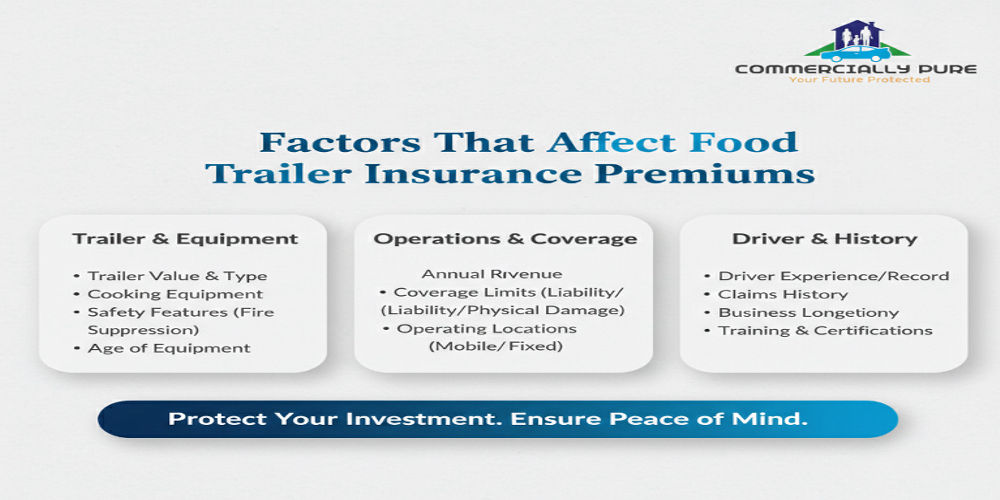
Factors That Affect Food Trailer Insurance Premiums
There is no ‘one size fits all’ answer to food trailer insurance. Insurers consider a variety of factors in setting premiums:
Location and traffic: Higher premiums are paid for areas that have more traffic or events (like concerts) or are in a high-traffic area.
What they serve for food: Companies consider less processed food less of a liability, and foods that could be contaminated, like raw seafood or sushi, as riskier and, therefore, higher rates.
Trailer and equipment value: The more expensive the value of the trailer and commercial-grade equipment, the more it will cost to replace, which translates to more property coverage costs.
Business size and revenue: The larger the business or has more than one trailer/ higher the revenue per year, the more likely it will be to pay more.
History of claims: No claims history may be less risk to the insurance company, and less cost.
Safety measures – premiums can be lowered if fire suppression systems, security cameras and locks are installed and training staff on proper food handling. Some insurance companies offer discounts if you are able to have written safety measures.
Driving record: Commercial auto coverage will be directly impacted by a good driving record.
What Food Trailer Insurance Will Cover?
There are a few kinds of coverages that will most often be lumped in a comprehensive food trailer insurance policy, which will address a particular kind of risk. With the knowledge of what each type covers, it will be easy to choose the appropriate combination that is ideal for your business.
General Liability Insurance
General liability insurance is the foundation of a food trailer policy. If a customer slips near your trailer and gets hurt or becomes ill after consuming your food, then general liability will cover legal costs, medical bills and any settlements. General liability insurance will most likely be required for your event and/or festival applications, and for a public permit.
Commercial Auto Insurance
Your trailer is always on the move, and commercial auto insurance is a requirement. It will cover accidents and collisions, as well as damage to the trailer during towing. Most policies will also include coverage for damage the trailer causes to other vehicles and/or property on the road.
Property Insurance
In case fire or damage caused by theft, vandal or natural disaster occurs and affects the entire trailer and the contents of the unit, then the property insurance will take care of it. This coverage is essential if your equipment is the means to your livelihood.
Equipment Breakdown Insurance
Equipment breakdown coverage will be available to repair or replace a critical piece of equipment, such as a refrigerator or fryer, that breaks down suddenly. This is especially crucial in the food industry as every minute of downtime can translate to lost sales.
Product Liability Insurance
If a customer gets sick or injured having eaten or drunk something you served, product liability insurance will help protect your business. Many cities, towns and states have laws that mandate product liability insurance as a condition of a health department permit.
Business Interruption Insurance
Business interruption insurance can help give you the option to replace the income should you need to temporarily close down due to an accident, fire or any other covered event. It can be used for things such as rent, utilities and wages for the staff while you recover.
Liquor Liability Insurance
If you serve alcoholic beverages, liquor liability insurance is an essential part of your food trailer insurance, as it protects you from claims resulting from intoxicated customers, whether it’s property damage or injuries occurring after they leave your food trailer.
Workers’ Compensation Insurance
If you have workers, workers’ compensation is required in most states of the U.S. Pays for medical costs and lost wages if a member of the team gets injured while working. The food trailer is a hot, sharp and cramped environment, and workplace injuries are certainly a worry.
Cyber Liability Insurance
Cyber liability insurance will help ensure the safety of your business in the case of a data breach or customer information theft if your business accepts online payments, if you have any online ordering system, and if you have any customer loyalty system.
How much is the monthly cost of Food Trailer Insurance?
The premiums of food trailer insurance fluctuate depending on the amount of coverage you are looking for, the value of your equipment and trailer, business size and location. These are some guidelines:
$26-$100/month basic general liability only.
Business owner’s policy (liability + property): $80-$140/month (or less or more)
Commercial Auto Insurance: approximately $100-$250 per month.
The liability, auto and property (full coverage) costs approximately $200 to $300 per month.
If your food trailer is small or you are a new owner, you can pay less. If you have a more expensive trailer, work in a busy area or have several employees, though, the premiums will be at the higher end of these ranges.
On average, how much does a food trailer insurance cost per year?
Usually, the yearly cost of a complete food trailer insurance policy is $2,000 to $5,000, or about $150 to $400 monthly. Generally, this covers general liability, commercial auto, workers’ compensation and property coverage.
How much you pay will depend on your equipment, where you are, your claim history, the kinds of food that you serve and the insurance provider you choose. Don’t hesitate to shop around and compare quotes, as it can make a world of difference when it comes to the annual premium.
How is Food Trailer Insurance a Legal requirement?
While the exact coverage that is required for a food trailer will vary based on the city, venue and state, the general types are:
If a trailer is being towed by a vehicle for business, it will usually be covered under a commercial auto insurance policy for the towing vehicle in most States.
Most states in the U.S. require workers’ compensation for any business that has workers.
General liability insurance is usually required prior to the local administration permits and/or festivals or events being issued.
Product liability coverage could be a requirement for a food service permit.
Fines, revocation of permits or closure may result if any of the required insurance policies are not maintained. Your company will remain compliant and avoid expensive fines from regulators by the use of the right coverage.
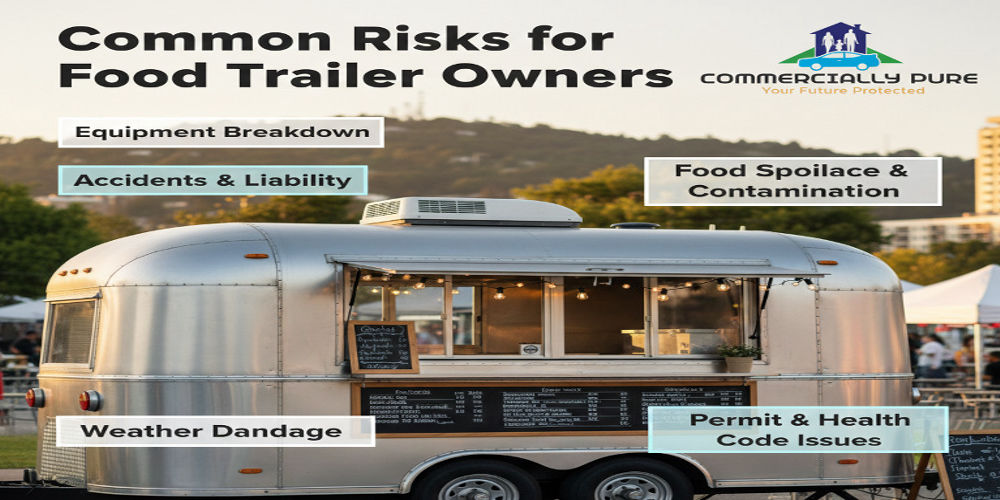
Common Risks for Food Trailer Owners
You can make a better choice about coverage if you understand the risks that you are taking. Food Trailer owners face some common dangers; they are:
Road accidents: There is increased risk of collision when towing a trailer that can be harmful to your vehicle, trailer or other vehicles.
Severe weather: If a trailer is left outside overnight, storms, floods and high winds can cause damage or even destroy the trailer.
Product liability exposure can be great if a customer suffers a food-borne illness from food you have served.
Equipment failures: When a refrigerator or fryer breaks down, operations could be brought to a halt, leading to lost revenue.
Theft and vandalism: Trailers can be left unattended at night, and this can lead to the loss of equipment, supplies or cash or vandalism.
Staff at risk from workplace injuries – hot equipment, sharp tools, heavy equipment, confined spaces.
Tips to Reduce Food Trailer Insurance Premiums.
When you’re seeking to reduce your food trailer insurance premiums, you don’t have to compromise on coverage. These are some ideas that may help:
Premium safety equipment: Fire suppression systems, security cameras and top-quality locks will reduce risk and could potentially reduce premiums.
Staff certification: Trained staff who have the appropriate food handling certification decrease the risk insurers see.
Drive safe: This not only keeps the cost of your commercial auto down but helps you to drive safely and obey traffic rules.
Multiple policies: It is possible to save money on various kinds of policies from the same insurance company.
Regularly review coverage: Your business continually evolves, and so should your insurance. Through periodic reviews, one is able to obtain the right amount of insurance coverage.
Insurance discounts for having proof of food safety training and compliance.
So, what are the differences between Restaurant Insurance, Food Truck Insurance and Food Trailer Insurance?
All three of these types of insurance are similar but serve different types of businesses.
A Restaurant Insurance policy is designed for restaurants with a stationary location. Generally includes general liability, commercial property (building and contents), workers’ compensation, business interruption and, if applicable, liquor liability. There are packages tailored to restaurants of large organizations like The Hartford, State Farm and Nationwide.
Food Truck Insurance is for Food Trucks. It incorporates commercial auto insurance (as the truck is a vehicle and place of business), general liability, product liability, equipment coverage and workers’ compensation. Progressive Insurance Company, The Hartford, and Nationwide, to name a few, have food truck policies.
Food trailer insurance is better suited for trailers that are towed, rather than self-propelled. It is a combination of commercial auto and business property coverages, as it provides coverage for the trailer, towing equipment and the commercial kitchen. In case the food trailer isn’t self-propelled but still needs to be covered in every detail when it comes to commercial coverage, then food trailer insurance is the best option.
There are two types of insurance: food trailer insurance and food truck insurance. The latter is ideal for mobile kitchens on food trucks—they serve as the main truck as well—but the former is ideal for those with mobile trailers.
Restaurant Insurance
A restaurant insurance policy can save restaurants from being out of pocket due to damage to their property, injuries to customers, injuries to employees, equipment breakdown, food contamination, and/or business interruption. Most restaurant insurance policies will include three types of insurance in one, all designed to help keep your restaurant running smoothly and successful: general liability insurance, commercial property insurance and workers’ compensation insurance.
Here are some coverages you may want to include in your restaurant insurance plan:
General liability (customer injury/damage to others’ property) coverage
Commercial Property Insurance (Buildings, Equipment & Stock)
Workers’ compensation (employee workplace injuries)
Business interruption coverage (loss of income as a result of closures)
Commercial kitchen failures or equipment breakdown coverage is the coverage offered by an insurance policy in case your kitchen equipment breaks down.
For small cafés as well as full-service restaurants, restaurant insurance is a crucial element to your food service agency. Operations could be impacted, and years of financial losses could follow, with only one claim or fire – if adequate coverage is not in place.
Insurance for Food Trucks that are in business.
Commercial food truck insurance is customized; it’s designed especially for the owner of a mobile food business. General liability coverage, commercial auto insurance, equipment coverage, property coverage, workers’ compensation coverage and product liability coverage are some of the coverage options. This type of insurance can provide food trucks peace of mind and shield them from potential accidents, lawsuits, and other unexpected risks associated with the business.
The commercial food truck insurance policy differs from car insurance or business insurance because it will cover problems that arise during the time that the truck is on the road, and liability for customers at outdoor events, as well as fire damage from equipment. Make sure the policy will apply to the different locations a food truck might use, such as at a private function, a festival, the public streets, etc.
Food Truck Insurance is required for the Go-Getters.
Mobile food truck insurance provides coverage for mobile food trucks. Some policy areas may be vehicle damage, cooking equipment, inventory, injuries to customers and business interruption. Mobile food vendors can benefit from choosing the right insurance coverage that will help protect them while offering their services.
Mobile food truck insurance may be more appropriate for mobile food trucks, like caterers or festival food vendors and roving street food trucks. In contrast, commercial food truck insurance may be more oriented to those with more established food trucks or locations. Evaluate policies and make sure they are inclusive for all operating territories and events.
The price of food truck insurance varies.
The type of food truck, vehicle size, geographic areas, history of claims and coverage options will all contribute to the cost of food truck insurance. The type of event or venue the business will be at may also dictate the insurance required – for example, festivals/catering events or a busy street.
These are some of the reasons why the costs of food truck insurance get higher:
High risk/high density areas:
Cook or serve high heat/flame foods (e.g. BBQ, frying)
Previous claims or bad driving record
Growth of value of equipment and vehicles
Broader coverage and less deductible.
Business owners can cut costs on their food truck insurance by consolidating coverages as much as possible, and by reevaluating their insurance policy on an annual basis for changes in revenue, business activity and more.
Purchase trailers to be used as food trailers.
Food trailers for sale are an excellent opportunity for an entrepreneur to start up a food business on the move on a budget. There are several sizes and layouts for food trailers, and depending on the needs of the business, commercial kitchens, food preparation equipment, and refrigerators and food serving windows can be added.
Food trailers are also more cost-effective than food trucks to buy and run, and are a great way to get someone started in the food industry. There are a few crucial things food trailer insurance buyers need to learn before buying a food trailer. These include the size of the trailer, towing requirements, conformance to local health codes and the customization options available.
Food Truck Trailer is a list of the food trucks and trailers that are on sale.
A food truck trailer for sale is a versatile option to regular food trucks. Some trailers are equipped with a built-in cooktop, storage, sinks, a ventilation system and serving counters. When buying a trailer, buyers should inspect the trailer and make sure that it complies with local health and safety regulations.
If you already have a tow vehicle that will work with a food truck trailer, you may want to consider a food trailer; if you are looking for complete freedom of mobility in your food truck, then a self-contained food truck may be the way to go. Before purchasing the unit, always request proof of previous use, a maintenance log and any permits and certifications of the unit in question.
Food Truck Sale
A food truck sale is an occasion for restaurants, catering companies, and street food vendors to purchase a new or used mobile kitchen. Before leaping into a food truck, purchasers should have an understanding of the cost, equipment, maintenance and licensing.
When it comes to buying, no matter whether you’re buying from a dealership, a private seller or an online marketplace, it’s essential to do your due diligence. Some of the most critical items to be checked off prior to signing a food truck deal are the mechanical inspection, local health department compatibility and the ability to transfer any permits.
Mini Food Trailer
A mini food trailer is a small, mobile food trailer design and is ideal for small food enterprises and startups. These trailers are designed to require less towing power, less maintenance and fewer issues during operation, while still accommodating all of the essential equipment to prepare and serve food in an efficient manner that requires less storage space.
A mini food trailer is ideal for small 1-man operations, specialty foods (dessert, coffee or snack) and smaller spaces. They also require less space, which can be beneficial for some jurisdictions in terms of permitting and parking. Prior to purchasing a mini food trailer, the company owner should make sure that the food trailer that they are buying is sufficiently large enough to accommodate the cooking appliances required to prepare the food on their list.
Used Food Trailer
A used food trailer might be the best option for entrepreneurs with limited finances to start up their business. Before buying the trailer, everyone should make sure it is in good shape, has adequate cooking facilities, plumbing, and electrical wiring, and meets all local health codes.
Choosing a used food trailer may be the better option if you don’t know much about the mechanics and/or have no inspection services, but a new food trailer would be the better choice if you prefer to have compliance and warranty. When purchasing a trailer, make sure you obtain maintenance reports, and the trailer configuration meets the health department regulations in the area you’ll be working.
British Food Near Me
When customers type in ‘British food near me’, they will be able to discover the restaurant, pub, bakery and grocery store closest to them offering British food. Fish and chips, shepherd’s pie, bangers and mash and your traditional English breakfast are all popular dishes.
When searching for British food, search on apps such as Google Maps, Yelp or food discovery apps and search terms such as “British pub near me” or “English restaurant” or “UK grocery store.” If you are in a city where there are lots of Brits, such as New York, Los Angeles or Chicago, there are restaurants and specialty food stores that cater to the Brits.
English Food Store
An English grocery store offering a vast range of English groceries, beverages, baking and specialty foods delivered from England. Ideal for people who wish to taste the real British products and dishes.
Most of the time, English food stores will stock products that are not readily available in mainstream supermarkets, such as PG Tips tea, clotted cream, British candy, Heinz beans (UK formula), HP Sauce, etc. Plus, Russia and food there are so many that come laced with baking goods that are often used in English baking, such as baking soda, which is referred to as self-raising flour.
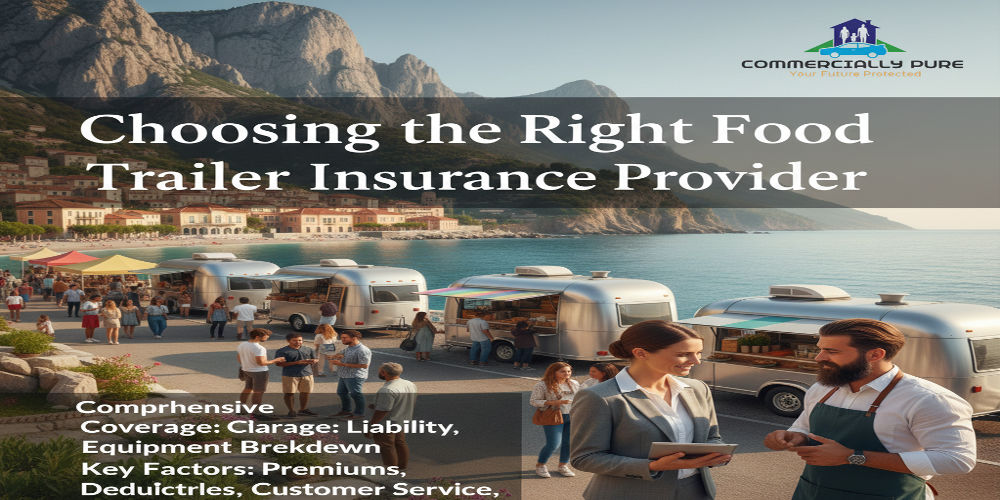
Choosing the Right Food Trailer Insurance Provider
Behind the name of the company you insure with, insurance is just as significant. While you’re searching for providers, look for the following:
Insurance carriers with experience in working with food trucks and/or food trailers. Progressive, The Hartford and Nationwide offer mobile food business plans.
Shop around: don’t settle for the first quote that you get. Obtain multiple quotes to discover competitive coverage at an affordable fee.
Evaluate claims handling: Your company could find itself vulnerable at the worst possible moments if claims are handled slowly or the claims don’t get answered at all. Read reviews and inquire about the typical claims resolution time.
Assess financial strength: Cooperate with insurers with good financial ratings, so that in the event of an occurrence, they are able to settle claims.
Find specialized agents: An insurance agent with knowledge of mobile food businesses will be able to help identify any gaps in coverage and be able to customize a policy to fit your business operation.
Foods from England
The English foods that have made the journey include the world-renowned cheddar cheese, Yorkshire pudding, Cornish pastie, scone, English tea, digestive biscuit, marmalade and traditional British confectionery; some of the best-known of the traditional English food and grocery products.
Some of the Yorkshire Pudding, Cornish pasties, and so on are local foods in England. Many English products are world famous to be exported to any part of the world. The best way to sample these products is to visit a British grocery store or specialty outlet and try out the real British foods.
Where to get low-cost meals in NYC
If you’re looking to dine out in New York City, food is an interesting topic to discover, and with a little bit of research, tourists and locals can find food trucks, delis and local restaurants in New York for low prices. There are lots of cheap restaurants in many of NYC’s neighborhoods.
The best places to find cheap food in NYC are neighborhoods like Flushing (Queens) for Asian cooking, Bushwick (Brooklyn) for a variety of street food and the East Village for an inexpensive international meal. Not to mention, there are food halls, pizza slices for a dollar or clusters of food trucks in Midtown Manhattan that can sate your appetite without the price of a restaurant.
Best Cheap Food in Washington DC
The best way to get cheap food in Washington, DC, is in local restaurants, food markets, food trucks and casual dining places that offer amazing and affordable dining. Without the big bucks, there’s a good selection of food for visitors.
The lowest budget food in Washington, DC, is to be found in areas like Columbia Heights, H Street NE, Adams Morgan, etc., cheap food near me, where there are many local cuisine international restaurants, all with low prices. Two other great markets for quality and variety and local character that don’t come with a hefty price tag are Eastern Market and Union Market.
Cheap Eats DC
A food lover can also find affordable dining options, such as budget-friendly restaurants, food trucks, cafés and local favorites throughout Washington, DC and enjoy good food on a smaller budget when planning cheap eats DC.
But some of the best food in DC can be found at food trucks serving food near the National Mall, Ethiopian food on the U Street Corridor or Vietnamese food at the Eden Center. As you’d imagine, DC’s food truck scene is quite strong, and many dishes are international and delicacies of all sorts to dole out at street-food prices in the hottest neighborhoods.
Pros
- Both restaurant insurance and food truck insurance provide restaurants and food trucks with financial protection in the event of damage to their property, liability lawsuits, and business interruption.
- However, mobile food businesses that have obtained proper insurance coverage can have peace of mind and mitigate financial risks.
- Food trailers are less costly choices than food trucks and a great way to start a food service enterprise.
- Used food trailers can lower the initial costs for a food business owner who has a tight budget.
- British grocery shops conveniently offer authentic British imports which are not found in the main supermarkets.
- In the larger cities, such as Washington DC and NYC, it’s easy to eat well on a budget; there is no dearth of cheap eats.
- Food trucks can provide different business opportunities and also have much less overhead than normal restaurants.
- Insurance is the way to recover from an unforeseen loss, liability claims and business interruptions.
Cons
- Insurance costs may increase and lead to an increase in monthly operating costs.
- Food trucks must be maintained, renewed and comply with regulations, as must food trailers.
- Some older trailers may require that you pay a considerable amount of money to upgrade them to meet health department codes.
- The cost of food imports from Britain could be even higher than the cost of food grown locally.
- At popular restaurants, tourists may have to wait a long time, or the restaurant may not be inexpensive.
- Mobile food businesses can be found in many different areas, and they need to comply with a variety of rules and permits.
- It’s important to read through the deductibles, exclusions and coverage limits in an insurance policy.
- The barriers to entry are low, but startup costs might be high for food businesses because equipment costs, licensing fees and insurance may be required.
Conclusion
From restaurant insurance to starting a food truck business, buying a food trailer, visiting a British grocery store or finding cheap food in NYC or Washington DC, it’s important to make informed decisions to secure success in the long run.
Food businesses may shield themselves from financial risks and liability exposure with the appropriate restaurant or food truck insurance policy. Efficient and compliant operations are made possible with good equipment – and the food trailers for sale or hire are included. But planning for both business owners and consumers, as well as comparing costs and conducting due diligence, helps them navigate the competitive food industry with their eyes closed.
Do some research and shopping to check out the price, coverage, quality of equipment, reviews and long-term value before buying insurance, buying a trailer, or selecting suppliers and restaurants to find the right fit for your goals and budget.
Answers to some of the commonly asked questions about Food Trailer insurance.
Q1: What is covered by food trailer insurance?
The specific coverages provided can vary from policy to policy. Still, a typical food trailer insurance policy contains general liability, commercial auto, property damage, equipment breakdown, product liability, business interruption and workers’ compensation.
Q2: Does a food trailer need general liability insurance?
Yes. Most event organizers, festivals and local permit authorities require general liability insurance in order to utilize the food trailer on public or private property.
Q3: Is a food trailer covered by commercial auto insurance?
Yes. Should the trailer be towed on public roads for business, then the trailer should be insured under commercial car insurance. Commercial towing will not be covered by the personal auto insurance policy you have.
Q4: Is it possible to insure several food trailers?
Yes. Many insurers offer multi-trailer or fleet coverage and can streamline your coverage and even provide lower premiums for each trailer than separate policies.
Q5: What are the costs of insurance for food trailers affected by?
When setting a premium, the following factors will be taken into account: Location, the type of food that is made, the amount of money that is made annually, how many employees, safety measures taken, and claims history.
Q6: Is product liability insurance a coverage that is appropriate for food trailers?
Yes. If customers are made ill or injured from the consumption of your product, product liability insurance will cover your business. This coverage is a requirement for several health departments in order to obtain a permit to operate.
Q7: What about workers’ comp benefits for workers at a food trailer?
Yes. Workers’ compensation is the insurance system in place to compensate workers for medical expenses and lost wages after a workplace injury. Most states in the United States require it for companies with workers.
Q8: Can a food trailer insurance policy cover theft of food equipment?
Yes. The property insurance covers theft and vandalism of equipment and stock. This is particularly critical when trailers are left in unsecured places at night.
Q9: Does food trailer insurance cover damage due to a storm?
Yes. Property insurance policies and business interruption insurance policies may apply to damages from storms, fire and other natural disasters and income for the reconstruction period.
Q10: What are the factors to consider when choosing a food trailer insurance company?
Be sure to choose an insurance company that has experience within the mobile food business; ask for at least three quotes, check the claims history of the company, ask for financial stability ratings and hire an insurance agent who is familiar with mobile food business insurance.
Q11: If food trailer insurance and food truck insurance are similar, what is the difference?
Food trailer insurance is for a food trailer that does not move on its own and is towed behind another vehicle, and food truck insurance is for any vehicle that will run on its own, including a commercial kitchen. It’s all about how they are used on the road.
Q12: Can you tax-deduct food trailer insurance?
In most cases, yes. Typically, business insurance premiums, including food trailer insurance, can be deducted as an ordinary and necessary business expense. Check with your tax advisor to see if this applies to you.