
Small Business Owner EIDL Hazard Insurance 2026 Explained.
SBA EIDL hazard insurance is a business property insurance requirement that is related to Economic Injury Disaster Loans (EIDLs). If the borrower’s business assets secure the loan, then the borrower is required to have SBA EIDL hazard insurance throughout the life of the loan. It is a layman’s guide on what it is, its importance, the amount required, and the consequences of non-compliance.
SBA EIDL hazard insurance is something many do not know about- what it covers or if their current policy is appropriate- for many EIDL borrowers. The following sections will address each of these questions directly, so you can be confident that you’re in compliance and that your business is protected.
EIDL Loan: What is it?
EIDL (Economic Injury Disaster Loan) is an affordable loan that is guaranteed by the United States government and is available to small businesses, self-employed individuals who are eligible, and nonprofit organizations for recovery after a federally declared disaster. They offer working capital for operating expenses like payroll, rent, utilities, etc., during disasters like wildfires, floods, and hurricanes, when cash is scarce.
EIDL loans are not grants—they will have to be paid back in accordance with the agreed loan terms. Their fixed rates tend to be low, and their terms are long, typically 30 years, and these terms are more affordable than a typical commercial loan.
Typically, EIDL loans to small businesses have an interest rate capped at 4% per year. Nonprofit organizations might be able to secure loan rates as low as about 2.75%. Physical damage loans can reach as high as 8% if there is an alternative for credit in the event of any physical damage.
What is an SBA EIDL hazard insurance?
SBA EIDL hazard insurance is a business property insurance policy that protects business property that has been pledged as collateral for an EIDL loan. It covers the event in case of a covered event such as fire, storms, sba hazard insurance theft and vandalism, smoke damage, and hail.
Both the borrower and SBA require this coverage. If the business is not insured, that could result in a loss of money for both the business and the lender in the event of major property damage. SBA EIDL Hazard insurance offers a backup solution to ensure that a business’s assets that are pledged in the loan are restored or replaced.
Please note: Hazard insurance for SBA EIDL is for physical damage. Does not offer liability coverage or coverage for lawsuits. Businesses should have a separate general liability insurance policy to provide coverage for liability protection.
What is the Hazard Insurance? (But How is It Different From Other Policies?
Hazard insurance is insurance that protects a property or business assets from physical damage from certain risks that are named on the policy, such as fire, windstorm, hail, lightning, and vandalism. It is not necessarily a stand-alone product, Alliance but rather is a component of a bigger SBA EIDL hazard insurance policy.
- Business hazard insurance is designed to help protect against damage events that affect a business’s assets and property.
- Homeowners hazard insurance is a type of insurance that is unique to the structure of a home. It’s usually part of a larger home insurance policy that includes coverage for personal property and liability.
- Hazard insurance is required on a mortgage because a lender is insuring the structure of the house that they are lending money against.
- General liability insurance is coverage for claims of bodily injury, property damage, and other legal costs to third parties, in addition to SBA EIDL hazard insurance coverage.
What’s the difference between hazard insurance and homeowners insurance? Hazard insurance is typically part of a house insurance coverage. Homeowners insurance is a type of insurance that people often have in addition to SBA EIDL hazard insurance, as it offers additional coverage for personal property and liability.
Is SBA EIDL Hazard Insurance for you?
Borrowers under EIDL must have SBA EIDL hazard insurance. Any loan over the SBA’s unsecured limit (historically $25,000) will normally be backed up by collateral, which means that the SBA EIDL hazard insurance will be required. This requirement may not apply to borrowers with unsecured loans of less than this amount, but it is good to check their individual loan agreement.
This varies by the sort of business:
If a business property endorsement is also adequate coverage for business property, the
- sole proprietor may elect to have coverage under both the endorsement and the personal policy.
- Normally, corporations and LLC’s would need their own commercial property insurance policy.
- If the nonprofit receives EIDL, then the same insurance requirements are applicable to them as to the for-profit borrower.
The key issue for the SBA is if the collateral assets are fully insured, irrespective of the borrower’s legal structure.
SBA EIDL Loan Hazard Insurance Options.
Typically, a standard commercial property insurance policy satisfies the SBA EIDL hazard insurance requirements for EIDL. Good policies will cover:
- Damage caused by fire and smoke.
- Storms and windstorms
- Theft and vandalism
- Hail and lightning
Business Owner’s Policies (BOPs) may be one of the types of policies that cover both property coverage and other coverage and can meet SBA requirements. The only requirement is that the policy is to insure damage to the business assets which are used to secure the loan.
Sometimes the below is also acceptable:
- Renters insurance with business property coverage (must have coverage for business-owned property and meet coverage thresholds per SBA).
- A homeowners insurance policy that includes a business endorsement (home-based business) provided the coverage limit is sufficient.
Does the SBA need to be on the policy? In a lot of cases, the SBA demands to be an interested party or loss payee on the SBA EIDL hazard insurance coverage.
EIDL
Businesses are eligible to access a financial assistance programme called EIDL (Economic Injury Disaster Loan) to aid in their recovery from the disaster they faced, which was declared. These loans are for working capital – meaning salary, rent, power bills, etc. – EIDL funding is for qualifying businesses to keep running during periods of economic stress.
Disaster Loan Assistance
Disaster loan assistance is a type of financial assistance available to business owners, renters, homeowners, and nonprofit organizations that have been affected by a natural disaster or other disaster or emergency that qualifies for assistance. Such loans can be used to repair damage property, purchase new equipment, and cover operating expenses. Eligibility and loan conditions will be dependant on the kind of disaster and applicants.
Economic Impact Loan
An economic impact loan can be used to address an economic difficulty for a business resulting from a disaster or unexpected economic disruption. The purpose of these loans is to keep businesses from failing so that they can continue to pay their staff, suppliers, rent, and other business requirements with working capital. They can be instrumental in the company’s recovery as well as keeping it running.
EIDL Loan Interest Rate
Generally, the EIDL loan interest rate is lower when compared to many traditional business loans and is an affordable rate of financing during times of crisis. The rate of interest depends on the eligibility of the applicant and type of loan. Before accepting an EIDL loan, borrowers must check out the latest rate and terms of repayment.
Business Hazard Insurance
Business hazard insurance can protect business property from physical loss or damage caused by a covered hazard, such as fire, storms, theft, and vandalism. It is typically a requirement for some commercial loans such as SBA loans. This coverage assists business owners in becoming profitable following unplanned property losses.
What’s an EIDL loan?
If you’re wondering, “What is an EIDL loan?” it’s a disaster loan for qualifying businesses that are affected by a disaster and have suffered a temporary loss of revenue, backed by the government. They are not grants but loans that must be repaid in accordance with the agreed repayment plan and loan terms.
Disaster Relief Loan
A disaster relief loan is a loan that is available to the people and businesses impacted by a disaster or emergency event, such as a hurricane, flooding, wildfire, or other disaster. As part of disaster recovery, the funds can be used to repair property, replace damaged equipment, or to offset some of the operating expenses.
SBA Disaster Loans Interest Rate:
Then, what is the rate of interest on SBA disaster loans? The interest rate will depend on the type of loan, eligibility of the borrower, and the current government guidelines. SBA disaster loans may offer more favorable terms and conditions than many of the other traditional financing providers in terms of interest rates and the length of time allowed to repay the loan.
EIDL Loan Payment Calculator
An EIDL loan payment calculator allows borrowers to determine the monthly payments according to the amount of the loan, interest rate, and duration of the loan. The calculator can help better understand the long-term borrowing cost and plan a business budget prior to taking out a loan.
The cost of business Hazard Insurance Coverage.
The value of the property, location of the business, type of business, coverage limits, and claims history are the factors affecting the business SBA EIDL hazard insurance cost. By getting quotes from several insurance companies, companies can discover a great deal about good insurance at an affordable cost.
Hazard Insurance for SBA Loan is one of the requirements to get an SBA loan.
A business asset is frequently required to be used as security for an SBA loan, and the insurance of such asset is often a requirement. This SBA EIDL hazard insurance helps limit the risk to both the borrower and lender of damages to the collateral coverage of the policy. Often the loan contract calls for maintaining a specified coverage.
Hazard Insurance Policy
A hazard insurance policy helps you to cover the costs of damage due to covered hazards like fire, windstorms, hail, lightning, or vandalism. Each provider will have varying details about the policy, and you should look into the risks, the limits, and the deductible prior to buying the policy. What is the difference between SBA EIDL hazard Insurance and Homeowners Insurance? Does Hazard Insurance include coverage for the same items as the Homeowners Insurance?
Homeowners insurance and hazard insurance can often be mistaken for one another, prompting many homeowners to ask,
Is hazard insurance the same as homeowners insurance?
Hazard insurance typically is a component of a homeowners insurance policy. Coverage for the structure of the home against covered hazards is included in SBA EIDL hazard insurance, but homeowners insurance can also include personal property or liability coverage.
What does Hazard Insurance on a Mortgage Mean?
One of the common questions among house buyers is, what is SBA EIDL hazard insurance on a mortgage? Hazard insurance may be required to protect the home on which the loan is being provided. The good thing about this insurance is that the property can be repaired or rebuilt if a covered event damages it.
Thus, what is Hazard insurance?
What is the insurance for risk of hazard? SBA EIDL hazard insurance is insurance against physical damage to a home or building from certain hazards like fire, storms, hail, or vandalism. Helps property owners after a covered loss to recover the costs for repair and/or rebuild.
What Is Hazard Home Insurance
The hazard home insurance is the part of the homeowners insurance policy that covers the home’s structure from covered hazards. It won’t generally offer protection to personal belongings and liability unless as part of a larger homeowners insurance policy.
General Liability Insurance
General liability insurance is a type of coverage that protects businesses against claims of bodily injury, property damage, and some legal expenses. It is regarded as one of the most crucial insurance policies that businesses have, since they help mitigate financial claims for lawsuits and third parties.
General Liability Insurance for Business
General liability insurance for business insures against general liability risks that occur in everyday business operations. Completely covers legal defense costs, settlements, and medical costs due to covered claims with customers, visitors, or other third parties.
Small Businesses Liability Insurance: What is the value of having the right insurance policy?
Small business liability insurance is a cheap mode of protection against customer/client lawsuits, property damage, and accidental injury. It helps small business owners to concentrate on expanding their business, and to limit the financial burden of any unforeseen litigation.
Business for Insurance
In insurance, business is usually a word for companies looking to have insurance products to protect their financial resources, equipment, personnel, and operations. Every company will have different risks, and you should choose insurance plans appropriate for your company, its size, industry, and operations.
There are a number of different kinds of business insurance.
Business insurance comes in a variety of forms, such as general liability insurance, commercial property insurance, professional liability insurance, workers’ compensation insurance, business interruption insurance, cyber insurance and commercial auto insurance. The mix of policies that a business selects will assist them in controlling risks and ensure its financial stability.
Do you know the SBA amount of Hazard Insurance required?
The coverage required by the SBA is the insurable value of the business assets used in the loan collateral, and does not have to be equal to the loan amount. The coverage limits need to reflect the current replacement cost of the insured property, including any equipment, inventory, and business assets that have been used as collateral.
Business hazard insurance cost is dependent on the following:
- The enterprise, its size and location
- The nature of the industry and risk are involved.
- Value of assets covered by debt
- The coverage limits and selected deductible.
- Claims history
Partnering with an expert insurance agent who has experience dealing with SBA loan insurance requirements can help borrowers determine competitively priced policies that comply with the requirements.
Deadlines and timing for EIDL Hazard Insurance Submission
The SBA will generally ask for proof of the SBA EIDL hazard insurance post-money disbursement and will inform you of a date by which you should submit it to the SBA. In general, businesses can secure a qualifying SBA EIDL hazard insurance policy after securing the loan and will have to deliver the documents in the time frame set by the SBA.
Follow-up notices may be sent for non-submission of proof of insurance by the due date. Communication with SBA and timely submission of documents can resolve most issues related to insurance submission compliance.
What Happens if you don’t Maintain SBA EIDL Hazard Insurance?
If the SBA EIDL hazard insurance on the SBA EIDL loan is not maintained, the borrower could be in “technical default. This does not necessarily have an immediate effect but may lead to:
- Higher level of scrutiny of the loan account by SBA.
- Other compliance conditions and requirements.
- There will be formal correspondence to request proof of coverage.
The biggest risk in addition to loan compliance is financial exposure. If coverage is not currently in place, a fire, storm, or theft event could place assets and monetary funds at risk that could not be replaced without insurance proceeds. This way, the business and its capacity to repay the loan are covered.
Coverage needs to be in place for the entire life of the EIDL loan. SBA may require renewals with their request.
Here are some common misunderstandings about SBA EIDL Hazard Insurance:
There are a number of misconceptions that lead to compliance issues for EIDL borrowers:
SBA EIDL hazard insurance is NOT required! If you are getting an EIDL loan using your business assets as the collateral, SBA EIDL hazard insurance is not something that could be added to the loan.
Business property is automatically covered by personal insurance.
A homeowner’s or renters insurance policy won’t cover the business property unless a business endorsement is included.
“Once I have proof of insurance, it is taken care of”. The coverage needs to be in effect throughout the life of the loan. It only takes one error for compliance to go off the rails.
“Hazard insurance is actually a liability coverage. It does not. There are other general liability insurance policies that are required to have liability coverage.
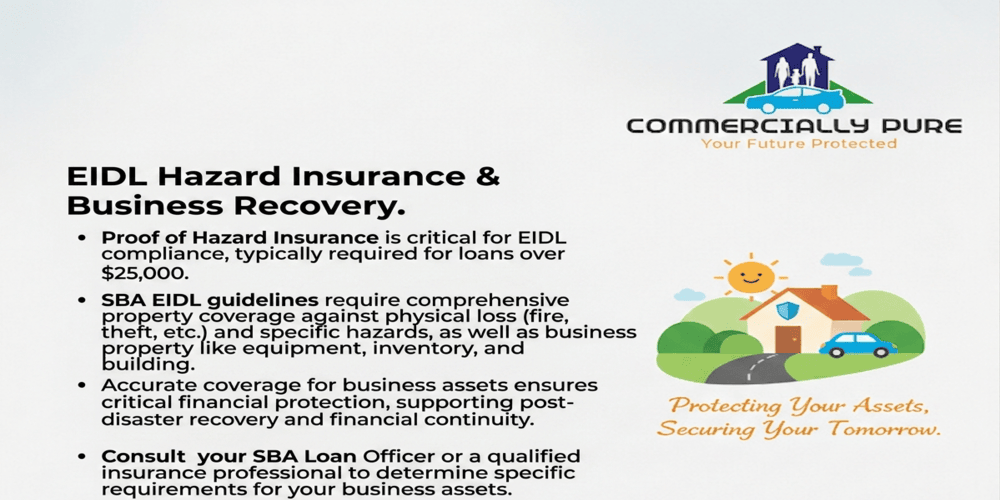
EIDL Hazard Insurance & Business Recovery.
SBA EIDL hazard insurance directly relates to a business’ disaster recovery. SBA EIDL hazard insurance policies would cover the business property, inventory, and equipment that are needed to operate a business, and EIDL loans can help businesses with working capital. When combined, these two financial instruments constitute a recovery platform for small businesses to help them sustain their businesses and recover from catastrophic events.
It’s not just a compliance issue; it’s continuous coverage. It is indeed a protection, and it can help businesses get back on their feet if any property-related calamity strikes without making their financial problems worse.
A quick rundown of the different types of business insurance available.
SBA EIDL hazard insurance is just part of a business’s insurance portfolio if they’re developing a complete risk management plan. The most favored business insurance policies are:
Commercial property insurance – Covers damage to commercial buildings, their assets, and property.
General liability insurance- Covers damage to third-party property, the third party’s bodily injuries, and legal costs.
Business interruption insurance: Provides coverage for lost income when a business is unable to operate due to a covered event.
Professional liability insurance – Protects against any claims of errors or negligence in professional services.
Workers’ compensation insurance- Provides coverage for employees’ injuries that happen at work.
Cyber insurance – Covers losses resulting from a data breach and/or cyberattack.
Commercial auto insurance: Auto insurance for cars that are being used for business purposes.
Different businesses, industries, and different types of risks will be present, and this means different policy choices.
Pros: Business Insurance and Disaster Loans
Financial Protection: Supports businesses to get back on their feet after accidents, property damage, lawsuits, and unexpected disasters.
Business Continuity: Insurance and disaster loans are relied upon to keep the business going during difficult times.
Legal Requirements: Certain insurance policies such as workers’ compensation or liability insurance may be required by law in your field and/or region.
Asset Protection: Covers business valuables like equipment, inventory, and buildings against covered perils.
EIDL and SBA Disaster Loans: These programs may have a lower interest rate and a longer term to pay back the loan than other loans.
Customer Confidence: Customers, partners, and lenders will have confidence in your professionalism with the right insurance.
Risk Management: Insurance can minimize the financial consequences of litigation, natural disasters, theft, and other unforeseen events.
Cons or drawbacks to Business Insurance and Disaster Loans.
Premiums: Insurance policies for businesses require premiums to be paid on a regular basis, which can be an additional expense in running the business.
Limits of Coverage: Insurance policies have coverage limits, deductibles, and exclusions that can result in some losses being uncovered.
Interest and Repayment: EIDL and other disaster loans are subject to repayment (with interest) regardless of the business outcome.
Application Process: Insurance claims and disaster loans can be a paper-and-pencil intensive process and can take a long time to process.
Premium Increases: If a company has many claims, then it could experience a premium increase at the time of policy renewal.
Eligibility Requirements: Not all businesses are eligible for Government disaster loan programs and some insurance options.
Potential Debt Burden: Large disaster loans may cause long-term debt repayment problems if not handled financially.
Conclusion
Business insurance and disaster loan programs are an essential element in preventing businesses from being left facing uncertain financial situations. Insurance offers protection against property damage, liability claims, employee-related risks, and other unforeseen events, and disaster loans like EIDL can be helpful during a disaster. These solutions work hand-in-hand to help businesses get back on their feet, safeguard assets, and keep businesses moving forward during tough periods. Before purchasing, shop for insurance or disaster loans, coverage, interest rates, terms of repayment, and qualifications to determine which is appropriate for your business and future financial goals.
Answers to some of the most frequently asked questions about the SBA EIDL Hazard Insurance are provided.
Q1: What is hazard insurance for SBA EIDL?
SBA EIDL hazard insurance is the business property insurance that is mandatory by the Small Business Administration in the event of an Economic Injury Disaster Loan that utilizes physical property as collateral. It is coverage for fire, storms, theft, vandalism, etc.
Q2: Hazard insurance is required for all EIDL loans.
Business asset loans (which are those over the SBA’s unsecured limit) must have SBA EIDL hazard insurance. Individual borrowers are advised to check their individual loan agreement to verify if coverage is necessary.
Q3: Does the EIDL hazard insurance cover liability claims?
No, covers physical property damage. No, physical property is not covered by hazard insurance. SBA EIDL hazard insurance. A general liability insurance policy should be in place to protect against liability claims.
Q4. Is there any way that homeowners insurance can be used to meet the EIDL hazard insurance requirement?
Yes, in some instances if the homeowners policy has a business property endorsement to cover the business assets which are used as collateral for the EIDL loan.
Q5: What is the Hazard Insurance requirement of an SBA loan of EIDL?
The SBA will have to be covered for the business assets used as collateral, NOT the entire loan.
Q6: What happens if I don’t provide proof of EIDL hazard insurance?
Failure to provide evidence of coverage will lead the loan to a technical default and may trigger SBA follow-up action and/or coverage requirements.
Q7: When is proof of hazard insurance needed?
The SBA usually requires a statement of insurance after the loan has been paid out, and sets a date for it to be submitted.
Q8) Will renters insurance be an acceptable source of or replacement for SBA EIDL hazard insurance?
Yes, if the renters insurance policy specifically includes coverage for the business-owned property and the coverage is at least that specified by the SBA.
Q9: Should SBA be identified on hazard insurance policy?
In many situations, the SBA needs to be an interested party or loss payee on the hazard insurance policy of the borrower.
Q10: How long do I have to carry hazard insurance on my EIDL?
To uphold the loan agreement, SBA EIDL hazard insurance should be kept for the entire length of the loan.