

Solar PPA: A Complete Guide to Solar Power Purchase Agreements
A PPA (Power Purchase Agreement) is a type of contract that allows a third-party solar energy system developer to install, own, and operate a photovoltaic (PV) system on a property. The property owner agrees to buy the electricity produced at a fixed price. Solar PPAs enable homeowners and businesses to gain access to solar energy without significant or any initial investment.
This guide includes all the answers to your questions on solar PPAs, how they work, who they are for, how they are different from other solar financing, PPA auctions, and questions to ask before signing.
What is a Solar PPA?
A Solar PPA is a contract between a solar developer and a property owner. No upfront cost to the property owner – the developer pays to install the solar system. In return, the property owner will buy the electricity produced by the solar array at a negotiated rate (usually less than that of the local electric company) for a specified time, usually between 10 and 25 years.
The stakeholders involved in a solar PPA:
Solar power provider — Finances, sets up, and runs the system for a solar developer
Property owner: Owns the system and sells the electricity produced by the system.
Solar PV system: Provides electricity whenever the sun is available to generate it
How does a Solar PPA work?
There are three phases to a solar PPA: agreement, installation, and operation.
Agreement: An agreement is signed by the property owner with a contract to purchase the solar electricity at a fixed rate for the duration of the contract.
Installation: The solar developer installs the solar system at their own expense and arranges the commissioning.
Operation: The property owner is only liable for electricity generated by the system. Developer to maintain, repair, provide quality care home health and monitor the system over the term of the contract.
Property owners are able to renew the PPA at the end of the contract period, or purchase the system at market rate or have it removed.
What are the benefits of a Solar PPA then?
There are a number of advantages to Solar PPAs, particularly if you are interested in saving money on your energy bills without the hassle of owning solar panels.
Payment made at no cost: Developer pays the entire cost of the equipment and installation.
Day one savings: PPA rates are often lower than the local utility rates, so there can be immediate savings in electric bills.
No maintenance responsibility: Developer owns the property and is responsible for all repair, monitoring, and equipment replacement.
One advantage of fixed or capped escalator rates is that they provide more predictable utility bills than variable rates.
Environmental benefit: Solar PPA can also reduce electricity generation using fossil fuels on the grid, and thus a property’s carbon footprint.
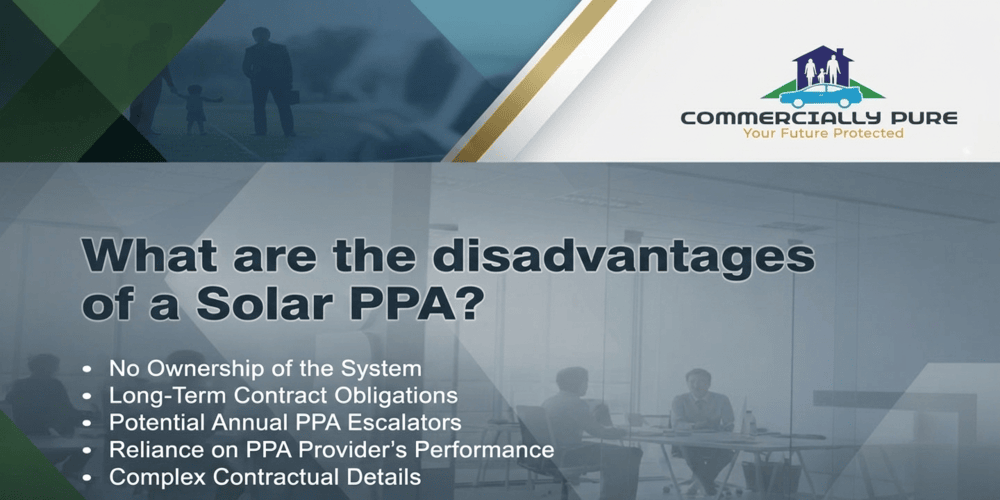
What are the disadvantages of a Solar PPA?
While solar PPA can make solar adoption more accessible, it also comes with its downsides and considerations to keep in mind before committing to a solar PPA.
No ownership of the system: Ownership of the system is not transferred to the property owner, but to the developer, and tax credits, incentives, and rebates are paid to the developer.
Long-term commitment in the contract: Contracts may be for a 10–25 year period, which can make it difficult to sell or refinance the property.
Annual escalator: Certain PPAs may include an annual escalator (1-3%) which will eat into any savings that might occur if utilities costs decline or are flat.
Limited geographic availability: Not all states have solar PPAs due to varying regulations.
Transferring complexity: PPA transfers can be somewhat complex, as the new owner may have to transfer the PPA to the new owner, or the new owner could be able to assume the contract for a buyout, but it is not always an easy process.
What is the difference between Solar PPA, Solar Loan and Solar Lease?
Third-party or financed solar are all types of solar PPAs, solar loans, and solar leases, and differ in their ownership and long-term financial outcome.
Solar PPA is more suited for property owners who do not want to make an initial investment, do not want to deal with the solar system, and would prefer immediate savings in their electricity bills (albeit small). They get paid based on the number of kWh that they produce (cents/kWh).
If a monthly payment is desired regardless of electricity generated by the solar energy system, then a solar lease is the best choice. The ownership remains with the developer.
Ownership of the solar system is transferred to the customer at the end of the solar loan, so it is best for homeowners who would like to maximize savings over the lifetime of the solar system and take advantage of tax incentives (like the federal Investment Tax Credit).
Who can enter into a Solar PPA?
Not all properties or locations are suitable for a solar PPA. The following will likely be factors in determining eligibility:
Solar PPAs are offered in some states in the U.S. that have favorable solar laws and regulations, including California, Arizona, New York, Colorado, and others.
Roof condition/orientation: Roofs need to be in good condition, preferably south-facing and with minimal shading.
Credit Score: Your credit score should be a vital factor; most developers would like to see a score of 650-680 and higher.
Electricity use – those that use a moderate to high amount of electricity tend to benefit financially the most.
Property type: PPAs are available for residential, commercial, and industrial properties, with different terms for each of the segments.
What Is PPA Solar?
PPA solar (Power Purchase Agreement solar) is a financing model that allows homeowners or businesses to have solar panels installed at little to no cost. A third party owns and maintains the solar system, and the customer pays for electricity generated by the system at a fixed rate. This setup allows for lower electricity costs without having to purchase the solar gear.
What is PPA (Power Purchase Agreement)?
PPA, or Power Purchase Agreement, is an agreement that is in place for a long time that involves the customer agreeing to buy electricity generated by a renewable energy source (such as solar panels) from a third party. PPAs are a popular choice for businesses, schools, and property owners looking to save money on energy bills without having to pay for the upfront solar investment.
What Are PPA’s?
Power purchase agreements are legal agreements that are entered into by an electricity-producing entity and a buyer. These commitments specify the terms and conditions, as well as the timeframe, of the renewable energy acquisition, such as solar or wind. PPAs deliver certainty of costs and help drive clean and sustainable energy.
So, what does a Solar PPA Agreement contain?
Solar PPA contract dictates the commitment of both the solar supplier and the buyer. The provider does all the installation, ownership, monitoring, and maintenance, and the customer pays for the electricity generated by the system at a predetermined price. In this way, the users will be able to enjoy the benefits of solar energy without having to pay for the installation or maintenance.
What Is PPA Energy?
PPA energy is electricity on contract, through a PPA agreement. This energy is typically generated from renewable power resources such as solar or wind farms. Companies and other entities utilize PPA energy to reduce the costs and expenditures associated with running, sustainability, and stabilized long-term electricity costs.
Car Auction: What is it?
A Car Auction is a sale of cars, where the highest bidder will get the car. Autos that are used, repossessed, government fleet, salvage, and dealer cars can all be auctioned. Getting a competitive price is possible, but it’s best to check it out first.
Philadelphia Auto Auction
The Philadelphia Auto Auction events have a huge range of selection of used, commercial, and salvage vehicles. These auctions are either for licensed dealers or, at times, public auctions. A vehicle comparison and a condition report will allow buyers to make an informed choice on which cars they would like to buy.
Auto Auction PA
An auto auction PA is a great opportunity for individuals to buy cars all over Pennsylvania for an affordable price. The auction offers everything from cars, SUVs, and trucks to motorcycles and commercial vehicles. Numerous auctions in Pennsylvania additionally have an online bidding system, making it much easier for those who are buying from a distance.
PA Car Auction
PA cars are available for purchase from PA dealerships, banks, government, and insurance companies at a car auction in PA. These auctions can have many types of cars and vehicles that are classified as clean title, repossessions, or salvage, with a variety of prices to satisfy every budget.
This will enable you to view information about Philadelphia, PA Parking Tickets.
Philadelphia PA parking tickets are parking citations that are issued for parking violations in the city of Philadelphia. Tickets may be paid online, by mail, or on-site (where applicable). To prevent any additional penalties or late charges, it is crucial to pay or appeal the parking ticket promptly.
What is Quality Healthcare?
Safe, effective, timely, patient-centered, and efficient are all characteristics of quality health care. Good health care is about getting it right – making a correct diagnosis, giving the right treatments, taking preventive measures, and continually getting better as time goes on so that better health and better patient results are achieved.
What does a good home care agency offer?
A high-quality home care agency is associated with expert assistance services for a senior, disabled person, or patient recuperating from a sickness or surgery. Typically, they’re provided with assistance to help them stay independent at home, such as personal care, companionship, medication reminders, and skilled nursing.
Home Health Care near Crossville, TN.
These local providers offer a variety of services like nursing and rehab, personal support services, medical care, and more to individuals in their own homes in Crossville, TN. These services offer you secure and comfortable healing as well as maintain your freedom.
What is Quality Home Healthcare?
The concept of good home care is to ensure consistent medical and non-medical care in the patient’s home. Services may include physical therapy, chronic disease management, wound care, and services to help with activities of daily living to improve health and quality of life.

New York Quality Healthcare Corp
New York Quality Healthcare Corp is linked to healthcare services that provide care to patients via home nursing, rehabilitation, therapy, and other medical help. When you’re choosing a good health service provider, you must look for licensing, caregivers’ qualifications, and patient satisfaction.
What is the PPA-CF Engineering Materials?
PPA-CF is a novel engineering material, combining the strength, chemical resistance, and thermal stability of Polyphthalamide with the strength of carbon fiber. It is also used in automotive components, electrical and other industrial machinery, ppa cf where durability is needed over extended periods.
What Is PAHT-CF?
PAHT-CF is a high-performance carbon fibre reinforced engineering thermoplastic. It can be used in challenging applications like aerospace, automotive, robotics, and industrial manufacturing due to its excellent mechanical strength, heat resistance, and dimensional stability.
So, what is PPA Filament?
PPA filament is a high-quality 3D printing material that is recognized for its strength, heat resistance, and low moisture absorption. Is commonly used to produce strong functional prototypes and end-use parts that require greater strength than standard printing materials.
What Is PPA-CF/GF?
PPA-CF/GF is a composite engineering material that is composed of carbon fiber (CF) and glass fiber (GF). The result is higher stiffness, strength, dimensional stability, and wear resistance, which is ideal for high-performance industrial, automotive, and engineering applications.
What Is PHAT-CF?
PHAT-CF is a carbon fiber-based 3D printing filament with the aim of producing components that are extremely strong but also light. It provides increased rigidity, lower weight, and better structural performance and is a popular selection for advanced manufacturing, engineering prototypes, and custom mechanical parts.
Pros and Cons
Pros
- Solar PPAs have little or no upfront costs and a decrease in long-term energy costs.
- PPA energy is a promoter of clean and renewable energy.
- PA car auctions have low costing for cars.
- Patients receive quality healthcare and home care services, enhancing their recovery and well-being.
- Advanced PPA-CF material has excellent strength, heat resistance, and durability.
- Carbon fiber engineering materials are light and have high-demand industrial applications.
- A large number of these solutions can provide quantifiable long-term financial and operational gains.
Cons
- Solar PPAs may be long-term contracts of 10-25 years.
- With most PPAs, customers do not own the solar system.
- Auctions may also have hidden problems, and limited warranties may apply.
- Medical costs could be high depending on the health care provider and the services required.
- The availability of home care services can vary greatly from region to region.
- The engineering grade PPA-CF, PPA-CF/GF, and other materials that are similar to the standard plastics come at a higher price.
- Special equipment and expertise are needed for manufacturing or 3D printing of carbon fiber materials.
- Some of the more advanced products/services are restricted in certain markets.
Conclusion
Whether it’s PPA solar financing, PA car auctions, high-grade home healthcare, or high-tech engineering materials such as PPA-CF, it’s good to be familiar with the pros and cons and what’s available before you commit. Solar PPAs can contribute to making renewable energy more affordable, car auctions can enable you to purchase an affordable car, quality home healthcare can enable the best patient outcome, and advanced PPA materials can enable the best mechanical performance in industry. Careful comparisons of the costs, features, contracts, and long-term value will enable you to determine the solution that best meets your personal, business, or engineering requirements.
Solar PPA Contract Key Considerations.
If they are considering entering into a Solar PPA, ensure that they are taking into account the following key elements of the agreement:
Rate and escalator clause: Establish the initial rate and whether it increases by a certain percentage every year.
Contract term: Understand the length of the contract and what it entails at the end of the contract.
Buyout clauses: Find out if there is a clause for buying the system at the end of or during a contract and what it will cost.
Transfer terms: Know how the contract works in the event of a property sale.
Performance guarantee: Clauses that guarantee a minimum amount of energy production with penalties if this is not achieved.
Termination fees: Understand the early termination fees, which can be high.
Will a Solar PPA still be worth it in 2026?
Financial goals, location, and plans will determine if a solar PPA is used.
If you want immediate cost savings with no investment or without owning the solar system and its maintenance, a solar PPA might be a good option. However, if you want to maximize your LTV and the tax credits are for you, you might get more financial return over the 20-25 year life of the system by purchasing or leasing a system through a solar loan.
Comparisons of how much homeowners save over the solar system’s lifetime show that those who own their panels outright save 2-3 times more than those on a PPA, primarily because of the federal Investment Tax Credit, which is currently 30% under the Inflation Reduction Act, and the fact that there are no ongoing payments.
Answers to common questions about solar PPAs
Q1: What is meant by PPA in Solar energy?
PPA = Power Purchase Agreement. In the solar industry, it is an agreement whereby a solar developer will install and own a solar installation on a property and the property owner will agree to purchase the electricity that the solar installation generates at a certain rate.
Q2: What is the difference between solar PPA’s and solar leases?
No. The property owner is charged for the electricity generated (kWh) in a solar PPA, but not in a solar lease. Both include a third party ownership of the system; the payment model is different.
Q3: If I have a PPA, am I able to purchase my solar system?
Most solar PPAs include a buyout option for the solar system at certain points during the PPA (such as year 5 and year 7) and at the final term of the agreement. For details, please refer to your individual contract.
Q4: Who will have my solar PPA if I sell my house?
Typically, when a solar PPA is attached to a home and it’s time to sell, there are two options: the solar PPA can be transferred to a new homeowner (must qualify and agree to terms) or an early termination fee is paid to terminate the solar PPA contract. This is an important consideration as not all buyers are willing or able to assume a PPA.
Q5: Will solar PPAs have an impact on my property taxes?
In most states, it’s not considered part of your property when it’s added to your home, so the value of the solar system is not included in the home’s property taxes. But tax regulations vary from state to state, and the advice of a local tax advisor is recommended.
Q6. Solar panels PPA maintenance:
In a PPA, the solar developer is responsible for all the maintenance, repairs, and monitoring. This is one of the main benefits of a PPA compared to outright ownership: the property owner is not responsible for maintenance or costs.
Q7: What is the savings potential of a solar PPA?
Actual savings will vary based on the local utility rate, availability of PPA rate, size of the system, and the amount of sunlight received. Immediate savings are for the property owner, who can expect 10-30% savings in electricity costs, and lower savings in the long term than if they were to own the system.
Q8: Are solar PPAs suitable for commercial property/business?
Yes. Commercial solar PPAs are quite prevalent and are a strategy that businesses, schools, nonprofits, and municipalities can use to lower electricity costs without putting any money up front. Business PPA terms and structures can vary from residential PPA terms.
Q9: If the solar system is underperforming, what?
Some solar PPA agreements stipulate a generation guarantee. If the system doesn’t generate the minimum amount of electricity promised, the developer may be responsible for paying back the property owner a credit or cash. Don’t sign without verifying whether a production guarantee is included.
Q10: Can I get out of a solar PPA early?
It is possible to cancel a solar PPA early, but this typically is associated with a fee in the thousands of dollars. There are fee contracts that are based on a flat fee or the value of the balance of the contract. Read the termination clause and consider it when considering the overall financial picture of the agreement before signing.