

What is CPI insurance, how it works and how to avoid it.
The Insurance on property that is loaned out, such as a car or home, and which is imposed by the lender when the borrower is uninsured, is called CPI or Collateral Protection Insurance. The lender obtains the policy and bills the borrower for it, which helps to protect the lender’s interest in the collateral. CPI insurance can also be known as “force placed insurance,” “lender placed insurance”, or “lienholder insurance.”
Typically, CPI is more costly than a standard personal insurance policy; provides less coverage; and is helpful to the lender, as opposed to the borrower. The initial step to stopping CPI insurance is to understand it.
Understanding the importance of CPI insurance.
CPI insurance, or Collateral Protection Insurance, is Insurance which comes into play when a borrower fails to maintain the required insurance coverage on a property still under a loan. When the lender becomes involved, the lender pays to buy a policy to back their financial interest in the goods, and the borrower is charged the cost of the policy either as part of the loan or as a monthly installment.
If you enter into a loan contract for a car or home, you’ll most likely find a provision that mandates particular insurance plan types. If you are getting an auto loan, a lender will usually require full coverage and collision coverage. Usually, they impose hazard insurance and flood insurance requirements on mortgage loans. If a lender does not maintain the cover, whether in a temporary or permanent state, then he doesn’t wait around and hope for the best. They implement a CPI policy and/or forward the bill to the borrower.
This is important to realize about CPI insurance: It’s not about you! It provides coverage on the lender’s investment. It may cover damage to the vehicle or home, but it is generally not as detailed as a policy that you would own. It wouldn’t include liability coverage, medical payments coverage and other coverage that you would be afforded with a new policy. The conditions are not as good, apta cpi and usually, the rate is worse than a borrower could get.
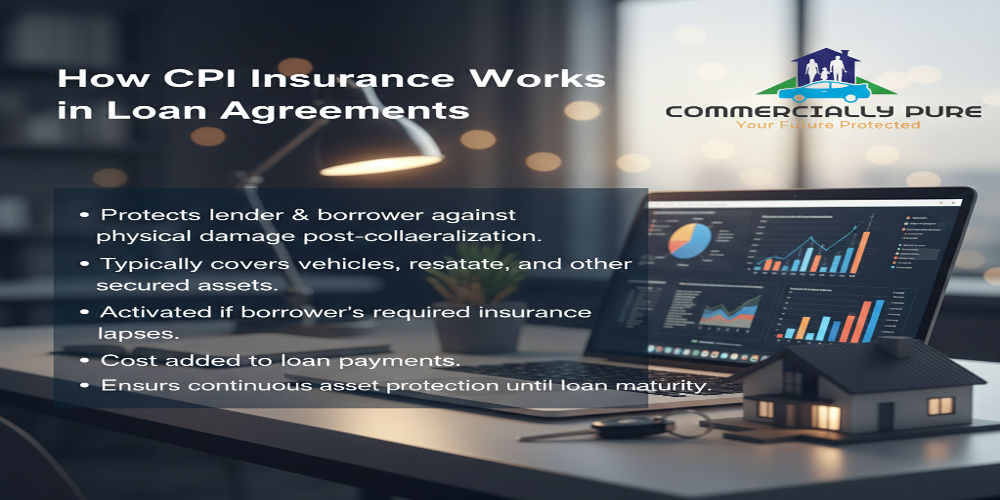
How CPI Insurance Works in Loan Agreements
Borrowers who finance a car or mortgage will not only have to pay back the loan, but they will also have to carry adequate coverage on the car or home during the life of the loan.
The process is normally as follows:
The Insurance must be provided prior to the start of any activity. For instance, a car loan lender will need to see that the person taking out the car loan is fully covered for liability, collision and comprehensive Insurance before the loan is finalized.
Lender does coverage monitoring. If there is an active loan, the lender or a tracking service monitors the borrower’s Insurance and will ensure that it remains active.
CPI placement takes place when there is a lapse in coverage. When the borrower’s insurance policy is reduced for non-payment, cancelation or is reduced to a level that is no longer satisfactory for the lender, the lender will place a CPI policy on the asset.
The fee is added to the loan amount. The CPI premium is paid by the lender and is due immediately or tacked on to the borrower’s loan amount or monthly payment, sometimes with extra charges.
The amount paid is to the lender. If something happens to the vehicle that’s covered under the insurance policy, such as an accident, theft or fire, then the insurance proceeds will go to the lender, not the borrower. The borrower is not supported in any way and has no liability, medical expenses or rental cars.
What Insurance is offered by CPI?
CPI insurance insures the financial interest of the lending institution, the asset, which is the collateral, and insures it also against physical damage. Coverage typically includes:
Accident damage (as in collision coverage on a standard car insurance policy)
Theft
Fire and vandalism
Specific events of nature (depending on the policy, such as floods, hurricanes, etc.).
CPI insurance is excluded for:
Damage or injury to other people
Cost of medical care/PIP coverage.
Coverage for uninsured and underinsured motorists.
Rental car reimbursement
Roadside assistance
Since the CPI only policy pertains to valuing the asset, the borrowers are not protected by the umbrella of the policy that a person would have in the case of a personally purchased policy. The CPI policies that lenders typically get from specialty insurers, such as Assurant and American Modern Insurance Group.
What’s the Difference between Collateral Protection Insurance for Auto Loans and Mortgages?
CPI insurance may be applied to many different types of secured loans; in each case, there are different details on the type of asset.
Auto loans: Comprehensive and collision coverage will be required by most lenders. If the borrower’s auto insurance policy has expired, the lender will purchase a CPI policy to safeguard the car, truck, or van from fire, damage, theft, etc. This policy does not provide liability coverage, and the borrower is legally exposed if his/her car is involved in an accident while on the road without coverage.
Hazard and in flood prone areas, flood insurance will be required by the lender on mortgages. At the end of a homeowners policy, the lender will most likely require the homeowner to have only the “dwelling policy,” that is, Insurance that covers just the home itself, not the homeowner’s personal property, liability coverage or additional living expenses.
Both times, CPI is calculated on the price to make sure the lender is protected and not necessarily competitive and comprehensive in the borrower’s protection.
How Does CPI Insurance Help Borrowers? Here are some key features and costs to consider:
CPI insurance is not like a normal personal insurance policy. Knowing some of the key features of what they are getting allows the borrower to determine what they are purchasing.
Coverage is narrow. The coverage for CPI includes at least physical damage to the collateral for the policy limit. This would encompass any ordinary consumer protections, which include liability, personal injury and uninsured motorist.
CPI will rarely be cheaper. CPI is placed by force, so the lender doesn’t consider the borrower’s track record, credit profile or claims history when determining the premium. Not competitively shopped; No discounts. In many instances, therefore, cpi log in CPI premiums can be a lot greater than what a borrower can get on their own.
The cost compounds. The lender charges the CPI premium, and interest is charged on the amount of the loan plus the amount of the CPI premium. A few months of forced Insurance could have a huge impact on the total cost of the loan.
Deductibles may apply. Whether the proceeds go to the lender or not, borrowers may be responsible for a deductible based on the policy provisions.
Charging the back/past is common practice. It’s not unusual to discover CPI premiums have been added to a borrower’s loan for several months before the borrower is alerted to the lapse.
What is CPI Insurance and why do Lenders use it?
CPI insurance is Insurance that the lender provides to protect their interest in the loan collateral in the event that the borrower does not maintain CPI coverage.
The loan amount is backed up by the value of the collateral when a bank or credit union makes a secured loan, such as a vehicle, home, or business equipment loan. When the borrower’s Insurance is terminated or when the asset is destroyed, stolen or severely damaged, the lender may end up with a loan that is more valuable than the asset. CPI insurance is a policy that removes this exposure.
Loan providers also use CPI as a tool to ensure that they stay in compliance with conditions of their loan contracts and that their loan portfolio is healthy. Many lenders have automated tracking systems which keep track of a borrower’s insurance status in real time. A gap will be identified, and CPI coverage can be activated automatically.
Dual-interest CPI policies can form part of certain loan agreements, and might offer some benefits to the borrower, cpi holds such as in the event of the collateral being damaged. But these policies are not commonplace, and borrowers should not assume that they will be covered as they might have been if the borrower had bought Insurance directly.
How to cancel or bypass CPI Insurance?
It’s easy to get uncovered by CPI insurance – make sure there is enough and regular Insurance on any property financed and tell the lender.
To avoid the onset of CPI in the first place:
Ensure that you have all the proper Insurance. This means that for an auto loan, it means that a comprehensive and collision plan is suggested in general. This includes hazard insurance and flood insurance (if applicable) on mortgages.
Include the lender as the lienholder. Be sure to have your insurance company list the lender as a lienholder or other interested party on the policy. This will allow your insurance company to follow up with a letter to the lender if there are changes in Insurance.
Provide insurance evidence in a timely fashion. When renewing, changing or transferring policies, always provide a copy of the policy to your lender, along with the policy declarations page. Don’t wait for their request.
To remove existing CPI:
If CPI is already in place on your loan, please reach out to the lender you are with and present documentation that you have adequate personal Insurance. When the lender is satisfied that the qualifying cover is in place, this will lead to the CPI policy being cancelled and the charges removed. Retroactive adjustments may be possible in some instances if evidence is provided to show that coverage was in place during the period that CPI was applied.
Personal Insurance is typically much cheaper than CPI — and provides a lot more coverage.
A list of insurance terms to know: CPI Insurance.
Some of the common myths surrounding CPI insurance that borrowers should confront head-on.
Misconception #1: CPI is similar to car insurance.
Physical damage to the vehicle only counts as CPI. Does not include liability, medical or uninsured motorist coverage. Those just using the CPI are not necessarily legally safe and may be liable for financial risk.
Misconception #2: CPI is provided for the borrower’s protection.
CPI is there to safeguard the financial interest of the lender. Any benefit to the borrower is incidental, and typically unimportant.
Misconception #3: CPI is only added if borrowers terminate their Insurance altogether.
The decrease in coverage that no longer meets the lender’s requirement, not including the lender as a lienholder, or not updating proof of Insurance because the coverage was changed from carrier to carrier, but coverage was actually continuous, can all trigger a CPI.
Failure to pay attention to detail can come at a high cost, as these are some practical examples: Borrowers have been charged months of CPI premiums when they changed insurance companies and did not send the new insurance documents to their lender. Others have had problems with the lender regarding charging it at the proper or correct time.
It’s important to read and understand the terms outlined in the loan agreement and the Insurance that will be required before signing.
Key Features of CPI Insurance Coverage
Collateral Protection Insurance, or CPI, isn’t comparable to the insurance coverage you would buy for yourself. It is primarily for the benefit of the lender, and not you. The coverage is generally quite limited, and it’s generally more expensive than an individual insurance policy. Just like the lender’s insurer doesn’t care about your risks, they care about their lender’s risks — like on a car or other piece of property they’re lending on. Most of the time, CPI will cover physical damage up to the policy limit.
Theft, vandalism, fire, etc., coverage is just like the coverage you would have with a regular auto policy, comprehensive or collision coverage. You’ll not receive extras, though, like liability coverage, uninsured motorist coverage and personal injury protection. These are present in most consumer policies and are not present in CPI.
The next fact—which comes with a high price tag almost 98% of the time—is that CPI is more expensive than buying your own Insurance! It is force-placed, meaning that if you don’t have a loan of your own already, the lender is adding it to your loan, and it is created to benefit the lender and not you! The special deals and discounts are not there; the driving record doesn’t matter—it’s just more expensive.
There may also be a deductible amount to pay in the event of a claim, depending upon the policy. But, as lenders add CPI to your loan or monthly bill, you may find that you have a higher bill than expected – particularly if you weren’t keeping a close eye on your own cover. The coverage that ends and the CPI coverage that starts can cost an arm and a leg.

What type of Insurance is Collateral Protection Insurance?
Collateral Protection Insurance, also known as “gap insurance,” is a policy that’s typically geared toward the financial interest of a lender on a financed asset, like a car, truck or vehicle, that may be damaged due to an accident, theft, fire or natural disaster. It won’t take the place of an individual auto insurance policy, and it typically provides no direct monetary safeguards to the buyer.
CPI is a general term used by various industries. This guide contains all of the three main meanings: Collateral Protection Insurance, Physical Therapy Clinical Performance Instrument and Crisis Prevention Institute training.
What is Collateral Protection Insurance?
If a required insurance policy on a financed vehicle or property can be allowed to lapse, Collateral Protection Insurance (CPI) is the Insurance the lender puts on the vehicle or property. The lender purchases CPI to ensure that the borrower’s collateral is not physically destroyed (accident, theft, fire, etc.) or otherwise lost until the borrower provides acceptable Insurance. The borrower normally pays CPI’s cost.
Remember, the primary purpose of CPI is to protect the financial interest of the lender, not the personal property and/or liability of the borrower.
Collateral Protection Insurance: What Does It Cover?
Collateral Protection Insurance offers some of the following coverage:
As a consequence of an accident, loss or harm to the financed vehicle or property
Loss of the insurance premium.
Fire damage
Some natural disasters to the secured asset:
Generally, Collateral Protection Insurance does not cover:
Any injury/damage to third-party property.
Medical services’ cost to the borrower or passengers
Car’s interior contents
Gap coverage is the difference between the amount that is still owed on the loan and the market value.
What is CPI Insurance for Loan Advance?
CPI loan advance insurance is a collateral protection insurance that is directly related to financed loans. The lender can buy CPI to insure the financed asset if a borrower does not keep up with their required Insurance. This is to safeguard the financial interest of the lender for the duration of the loan, even if the borrower is insured.
What’s Collateral Insurance?
Collateral is Insurance that covers property that is used as a security for a loan. Insurance on financed assets, like vehicles or equipment, is a frequent requirement by lenders on borrowers. The lender can also secure coverage protection insurance if coverage falls off to mitigate its financial risk. Collateral insurance” is a term that is often used in place of “collateral protection insurance.
Common Misconceptions and Real‑World Scenarios
Many people believe that CPI insurance is similar to normal car insurance, but this is not the case. CPI typically only provides coverage for damage to the car and not liability coverage, medical bills or any of the other coverage you may have in your personal coverage. So if you have CPI, you would still need to carry the necessary Insurance, for example, liability insurance, especially for your vehicles. One other point people do wrong is considering CPI somehow assists the borrower.
It doesn’t. CPI is all about safeguarding the lender’s money, not yours. Do a bit of research online, and you’ll find a number of such tales of people who were taken aback by how expensive CPI can be, and how hard it is to get rid of sometimes, despite having adequate coverage.
Sometimes, the borrowers forget to add the lender’s name as a lienholder on their Insurance. In real life, the CPI charges have been levied on an individual who merely switched from one insurance company to another and who failed to get the insurance information to the lender on time. Others even find themselves in conflict with the lenders as to whether those CPI charges were or were not fair or properly applied. It’s simply a good sign of how critical it is to actually read your loan terms, understand insurance requirements and to tell your lender whenever there is a change in your Insurance.

In other Industries, what is CPI?
The term “CPI” may stand for a number of different things in various contexts. Breaking it down:
Physical Therapy Education in the state of Pennsylvania.
In physical therapy education, CPI is an acronym for Clinical Performance Instrument, which is a standardized instrument which is used to assess physical therapy students during clinical placements. It evaluates professional conduct, clinical thinking, technical competency in the care of the patient, and communication skills.
The latest version of the instrument is the Physical Therapy Clinical Performance Instrument (PT CPI 3.0). It provides electronic documentation, standardized assessment measures and monitoring of performance to ensure a program is consistently and objectively assessed.
Physical Therapy CPI Login: Students, instructors and clinical educators can securely log in to the CPI login portal to complete evaluations, review progress, submit assessments and monitor performance online.
SCCES (Clinical Performance Instrument Web-based System) is a system which supports physical therapy clinical education by securely accessing evaluations, student assessments, and clinical education records online.
CPI Learning is an online learning platform where you can access CPI training courses, certification programs, educational resources and continuing education materials. Certifications are displayed, and training can be found in the secure portal.
CPI Education and Workplace Safety.
CPI can also mean the Crisis Prevention Institute, a firm which provides educators, healthcare workers and school personnel with behavior management and de-escalation training.
CPI Nonviolent Crisis Intervention Training is a course for healthcare providers, educators, caregivers, and staff to learn how to prevent, defuse and manage disruptive and/or aggressive behavior safely. A focus of the program is on verbal de-escalation, crisis prevention and safe intervention strategies that have dignity and safety as the primary concern.
Pros
- Collateral Protection Insurance is intended for the lender to protect them against loss.
- CPI arranges financing for the asset when a borrower’s coverage ends in order to keep the asset covered.
- Physical Therapy CPI offers a uniform assessment of students.
- With the online CPI platforms, assessment and record management are easy.
- Crisis Intervention training enhances the safety of the workplace.
- CPI training is not about the use of restraint or seclusion, but about effective de-escalation and communication.
- Certification Programs facilitate Professional Development.
- Standards-based assessment systems help to increase the consistency of the education.
Cons
- Collateral Protection Insurance is considered a lender’s Insurance.
- The total cost of a loan could rise because of CPI premiums.
- Continued re-training and re-certification may be required.
- There is a time and monetary investment involved with CPI courses.
- Physical intervention techniques should be properly certified.
- The software in assessment systems could be subject to periodic updates.
- Online platforms must have secure Internet connectivity.
- There are several different meanings of the term “CPI”, so terminology can be confusing.
Conclusion
The meaning of CPI is very important to understand, as it is applied to a few different industries, like Collateral Protection Insurance, Physical Therapy CPI or Crisis Prevention Institute training. Collateral Protection Insurance for lenders, Clinical Performance Instrument for health care education, and Crisis Prevention Institute training to develop effective crisis management training skills and enhance safety. When purchasing products, compare the various features, costs, certification requirements and benefits of the various platforms and decide which is most appropriate for your personal, education and/or professional needs.
CPI Training Cost: CPI training may be different for the various levels of certification, course formats and training providers/organizations. The fees are dependent upon the program: online, in-person workshop, instructor certification, group sessions. Before signing up employees, organizations should check the price and features.
CPI Hold: CPI hold is a learned and proven method of physical intervention from CPI training which is used only when necessary during a behavioral crisis. These techniques should only be carried out by appropriately qualified personnel, following organizational procedures.
Participants are expected to read through the official training materials and work through the exercises and questions prior to the certification exams and not discuss the answers with the other participants. It’s more effective – and safer – to know the principles of crisis prevention than to remember answers.
Some of the most common questions concerning CPI Insurance.
Q1: What is CPI insurance?
CPI insurance is an acronym for Collateral Protection Insurance. A requirement set by a lender (not the borrower) on an asset being financed (such as a car or home) if the borrower does not have the insurance coverage required. The borrower pays the cost by having to add to the loan payments or to increase the amount of the loan.
Q2: Who will be responsible for paying for Insurance for CPI?
The borrower pays for CPI insurance, but the lender purchases the policy. The premium is tacked on to the borrower’s loan balance or monthly payment, so the borrower is also charged interest on the insurance premium.
Q3: Is there Insurance for the borrower under the CPI?
No. CPI insurance is meant to insure the financial interest of the lender in the collateral. It offers no liability coverage or other consumer benefits of a policy that a consumer might have bought on their own.
Q4: How much does the CPI insurance cost?
Generally, CPI insurance is more costly than coverage that you purchase yourself. The lender doesn’t consider the borrower’s driving record, credit score, claims history or other factors when deciding the premium, as it is force-placed. No competitive rates or discounts are available.
Q5: Is it possible to cancel the CPI insurance?
The lender shall cancel the CPI policy and stop paying the monthly premiums when the person has obtained personal insurance coverage (PIC) satisfactory to the lender and submitted evidence.
Q6: Does an insurance policy like the CPI affect the borrower’s credit score?
CPI will not directly impact a borrower’s credit score. But if you don’t keep your Insurance up to date, it can lead to a loan default, and any increase in loan balance or missed payments could have a knock-on effect on your credit.
Q7: What is the difference between CPI and force-placed Insurance?
CPI insurance and force-placed Insurance are the same. The two main components of the policy are the way in which the policy is applied (force-placed) and the type of object covered by a policy (CPI).
Q8: Is CPI insurance gap insurance included?
Gap insurance fills in the gap between the amount that is owed on a loan and the cash value of the vehicle if it becomes totaled, and the borrower purchases it to benefit the borrower. The lender purchases CPI insurance, and it only protects the lender’s interest in the loan and not any deficiency in the borrower’s loan balance.
Q9: Does CPI insurance have an impact on credit?
Yes, indirectly, because if CPI states that the required insurance coverage isn’t being maintained, it may have a negative impact on loan compliance, but CPI doesn’t necessarily impact credit scores.
Q10: Is it necessary to buy my own Insurance or can I use CPI?
Absolutely. You can buy your own policy, which is usually cheaper and will be more comprehensive that meets lender requirements without having a force‑placed CPI policy.